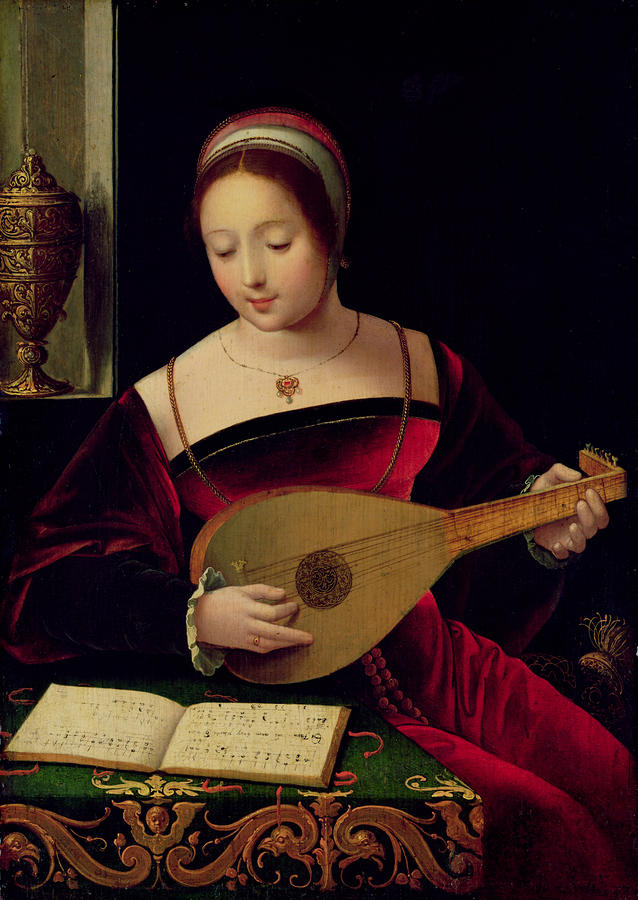
 | |
| Mary Magdalene playing the lute |
Sunday, November 16, 2014
Soon to gather momentum...

Tuesday, October 21, 2014
Mousike
My lute teacher has lent me a book called "A History of the Lute from Antiquity to the Renaissance," by Douglas Alton Smith, which is an invaluable source for me.
As I began flipping through, I came across a little section at the beginning which illustrates how the lute was valued in education in antiquity. Smith quotes Plato:

As Smith explains, in the Hellenic philosophy of moral education, "mousike" was a coinage from muse-ic, which meant "pertaining to the muses." Music meant not just music, but also poetry, song, dance -- all the attributes of the muses.
This definition -- or now re-definition -- of "music" lays a threshold for a study of the lute that branches in countless cultural directions. The expanded definition connects the lute to disparate aspects of society, and I don't think it is wrong in doing so. The lute's cultural inter-connectivity is what makes it so interesting and remarkable.
As I began flipping through, I came across a little section at the beginning which illustrates how the lute was valued in education in antiquity. Smith quotes Plato:
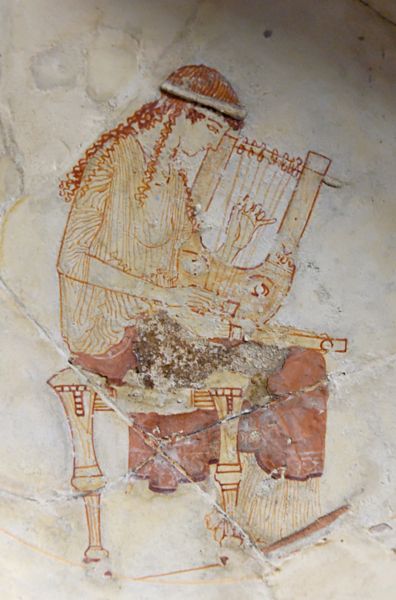
"...Isn't training in mousike of overriding importance, because rhythm and Harmonia penetrate most deeply into the recesses of the soul and take a powerful hold on it, bringing gracefulness and making a man graceful if he is correctly trained, but the opposite if he is not?" [Plato's Republic, Book III]
As Smith explains, in the Hellenic philosophy of moral education, "mousike" was a coinage from muse-ic, which meant "pertaining to the muses." Music meant not just music, but also poetry, song, dance -- all the attributes of the muses.
This definition -- or now re-definition -- of "music" lays a threshold for a study of the lute that branches in countless cultural directions. The expanded definition connects the lute to disparate aspects of society, and I don't think it is wrong in doing so. The lute's cultural inter-connectivity is what makes it so interesting and remarkable.
Wednesday, October 8, 2014
Weird Lute Wednesday
| "Can't Touch This" |  | ||||||
| Jan van Bijlert -- Young Man Playing Lute, 1625
Jan van Bijlert – Young Man Playing the
|
Wednesday, October 1, 2014
Weird Lute Wednesday
. . . When you get to see the not-so respectable side of the lute.
Here's is a pretty creepy looking lutenist for your enjoyment!
Here's is a pretty creepy looking lutenist for your enjoyment!
 |
| Frans Halls, "The Lute Player" 1625-26 oil on canvas 28x25in The Louvre |
Monday, June 23, 2014
Bergamescas and Personal Buffoonery
Grounds in Context
Taught by Chris Morrongiello, it's a look at the basic themes and chord progressions from the Renaissance and Baroque periods. These "grounds" were used in much the same way that a 12-bar blues is played and improvised upon today.
The Bergamesca is one such melodic pattern that originates from the Bergamo region of Northern Italy, based on a progression of 1-4-5-1. Bergamo was known for the tradition of Comedia del Arte, baffoons, and fools, so the bright and jovial Bergamesca is associated with liveliness and jest.
On the final day, there was a participants' concert, who lute campers might try their musical skill before an audience. In a fit of late-night poor judgement, ather young lute player I'd befriended and I decided we should sign up to play something. Now she, although modest about her skill, had nine years of playing under her belt; I had about four months. We got the stage jitters together and felt a sheepish comradery as we rehearsed our piece. She played the melody and I strummed along, and appropriately, we played a Bergamesca. It seemed fitting for both its simplicity and for highlighting the younthful buffoonery with which we carried out the performance.
Sunday, June 22, 2014
Lute Camp
On Arrival
I had never imagined such a thing as "Lute Camp" might exist. It is the biennial Cleveland Lute Festival, held at Case Western Reserve in Ohio. The week brings together an incredible selection of the world's most prestigious lute players, makers, and historians.
Before the seminar dives into such courses as "Understanding Francesco" and "Lute Music of the German High Baroque Rhetoric," we were met with a concert of Italian lute music form the 16th century. Nigel North is an outstanding lutenist from England, and he titled the concert "A Decoration of Silence." The name couldn't have been more apt, for I have sat through more than my fair share of classical concerts and never before has an audience been more rapt and quiet. As one of the audience phrased it, everyone was waiting to hear the first note be spun.
I had never imagined such a thing as "Lute Camp" might exist. It is the biennial Cleveland Lute Festival, held at Case Western Reserve in Ohio. The week brings together an incredible selection of the world's most prestigious lute players, makers, and historians.
Before the seminar dives into such courses as "Understanding Francesco" and "Lute Music of the German High Baroque Rhetoric," we were met with a concert of Italian lute music form the 16th century. Nigel North is an outstanding lutenist from England, and he titled the concert "A Decoration of Silence." The name couldn't have been more apt, for I have sat through more than my fair share of classical concerts and never before has an audience been more rapt and quiet. As one of the audience phrased it, everyone was waiting to hear the first note be spun.
Subscribe to:
Posts (Atom)